

Rare diseases

What is meant by rare diseases?
In the United Kingdom, ~3.5M people in the UK are affected by a rare disease. A single rare disease may affect up to about 30,000 people, though the vast majority of rare diseases will affect far fewer than this. Rare diseases include rare cancers such as childhood cancers, and some other well-known conditions such as cystic fibrosis and Huntington’s disease1.
Worldwide, 263 to 446 million people have a rare disease, which equates to between 3.5% and 5.9% of the world population2.
Today, more than 7000 rare diseases have been identified worldwide, 80% of which are of genetic origin. Haemophilia, Primary Immunodeficiency (PID), immune-mediated neuropathies, deficiencies of certain proteins, are all rare diseases that profoundly affect people’s lives.
Rare diseases in figures:
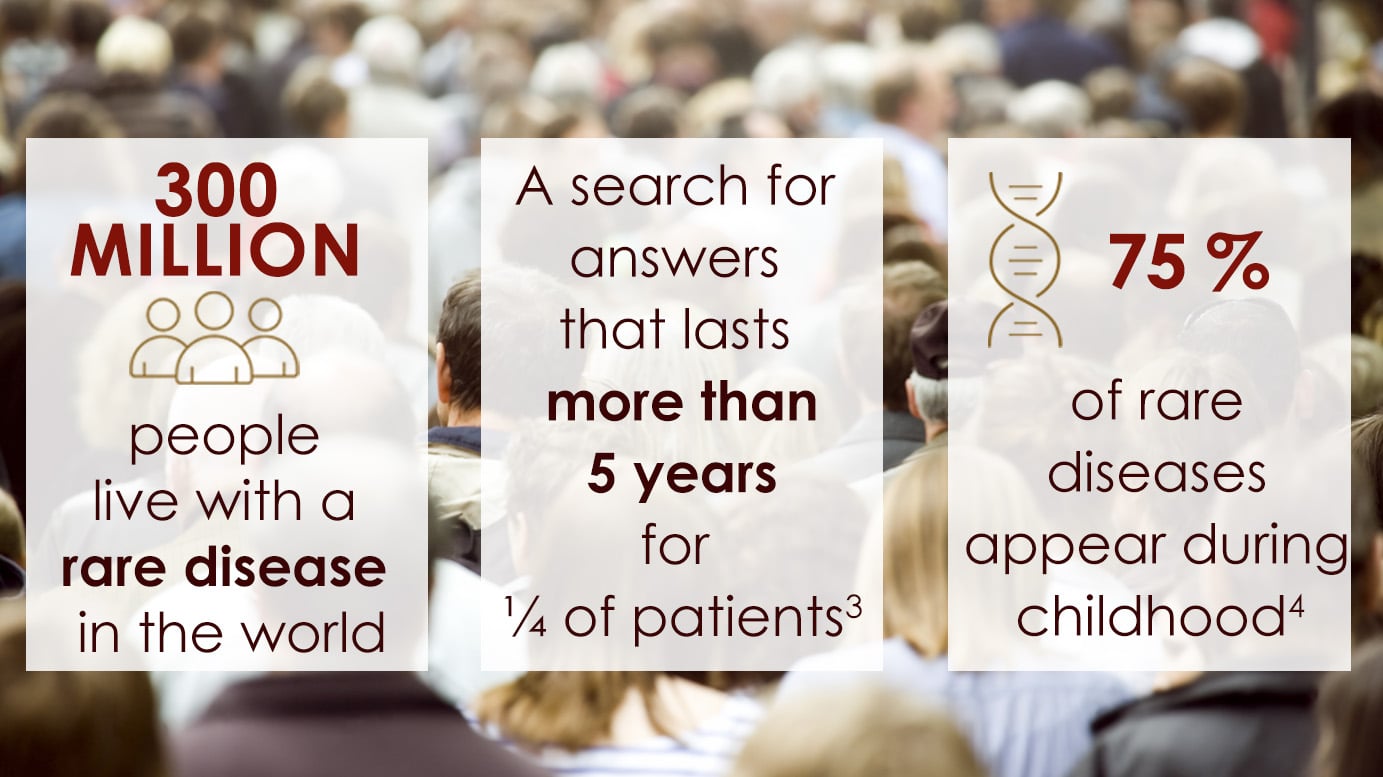
Most rare diseases are severe, disabling and chronic.
They significantly affect the quality of life and daily activities of patients.
Some give rise to motor disorders, such as Chronic Inflammatory Demyelinating Polyradiculoneuropathy (CIDP), which causes problems with walking, balance and difficulty with fine motor skills such as opening a bottle or buttoning a shirt.
Blood clotting disorders are also rare diseases, one of the best known of which is haemophilia, where the blood does not clot following a wound or cut.
Other rare diseases affect a certain population, such as Familial Mediterranean Fever, which, as its name suggests, affects people from around the Mediterranean basin.
To learn more:
The human body is defended and therefore protected by the immune system. One of the main functions of the immune system is to protect the body against external attacks, that is, from pathogens, such as viruses, bacteria or parasites.
When this system fails, meaning that one of its components is absent or defective, this results in what is called an Immunodeficiency.
There are two types of immunodeficiencies: Primary immunodeficiencies, linked to the absence or defect of one of the components of the immune system, and secondary immunodeficiencies, which result from a serious long-term illness, or may appear following the administration of a medicinal product.
Primary Immunodeficiencies (PID) are rare genetic diseases that affect both children and adults and cannot be cured.
Several treatments are available, depending on the severity of the PID. Some patients take antibiotics for infections, while others need regular treatment with antibodies, or immunoglobulins extracted from plasma. Other available treatments include stem cell transplant or gene therapy
In the United Kingdom, more than 4,500 people were known to suffer from a PID5.
Haemophilia is an inherited genetic disease.
In the event of a wound or shock, the coagulation process is activated to stop the bleeding. This process is called the coagulation cascade, which involves proteins called coagulation factors.
When one of these factors is lacking, clotting is almost impossible and severe haemorrhages and sometimes spontaneous bleeding in joints are observed. This is what is called haemophilia.
There are two types of haemophilia:
- haemophilia A: the most common form, which is characterised by a deficiency in coagulation factor VIII.
- haemophilia B: the more rare form of the two, which is characterised by a deficiency in coagulation factor IX.
Treatment consisting of administering the clotting factors which are lacking, whether using clotting factors derived from plasma or recombinant proteins, can allow a haemophiliac to lead a near-normal life.
To date, there is no treatment that can “cure” haemophilia.
Why are mainly boys affected?
Haemophilia is transmitted through the X chromosome. Boys have one X chromosome and one Y chromosome, unlike girls, who have two X chromosomes. If one of their X chromosomes is affected, the haemophilia is compensated for by the second X chromosome. Girls are therefore only very rarely affected.
Around one in 2,000 men, women and children in the UK have a diagnosed bleeding disorder, which is almost always inherited6.
Sources :
1: https://www.genomicsengland.co.uk/genomic-medicine/understanding-genomics/rare-disease-genomics
2: “Estimating cumulative point prevalence of rare diseases: analysis of the Orphanet database“ Authors: Stéphanie Nguengang, Wakap, Deborah M. Lambert, Annie Olry, Charlotte Rodwell, Charlotte Gueydan, Valérie Lanneau, Daniel Murphy, Yann Le Cam & Ana RathDA – Published 2019/09/16 in the European Journal of Human Genetics.
3: https://alliance-maladies-rares.org/nos-combats/
4: https://sante.gouv.fr/IMG/pdf/pnmr_3_v25-09pdf.pdf
5: Abolhassani, H., et al. Global systematic review of primary immunodeficiency registries. Expert Review of Clinical Immunology, 2020,16(7), 717–732.
6: https://haemophilia.org.uk/bleeding-disorders/
Job Code: NP-25/10/001 – Date of preparation: November 2025